Three weeks · three documents · yours to keep
And why you should listen to any of this.
We map where AI actually pays off inside a service business, build the solutions that earn their place, and hand every one of them to a named person on your team.
Most firms in this space want to hold the keys. We build the system inside your business, then make sure it runs without us.
We don't resell a platform and we take no vendor commissions, so the recommendation is never a commission. If the right answer is a tool you already pay for, that's the answer you get.
Ben Lane. Seven years building automation and AI systems inside service businesses — healthcare, fitness, trades, professional services. Every engagement is run by him personally. There is no account manager layer, because in three weeks there is nothing for one to do.
The work is deliberately built so you don't need him afterwards. That isn't modesty, it's the product.
Almost every business that comes to us has some of these problems. Most have most of them.
Pick the ones that sound most like you right now.
They look like eight problems. They are one: you can't prioritise what you haven't mapped.
Answers problems 01 · 02 · 03
Answers problems 04 · 05
Answers problems 06 · 07 · 08
Fully costed. Fully planned. Clear ROI.
Not a slide deck of recommendations. Three working documents your leadership team can act on, quote from, and hand to whoever builds it — including if that isn't us.
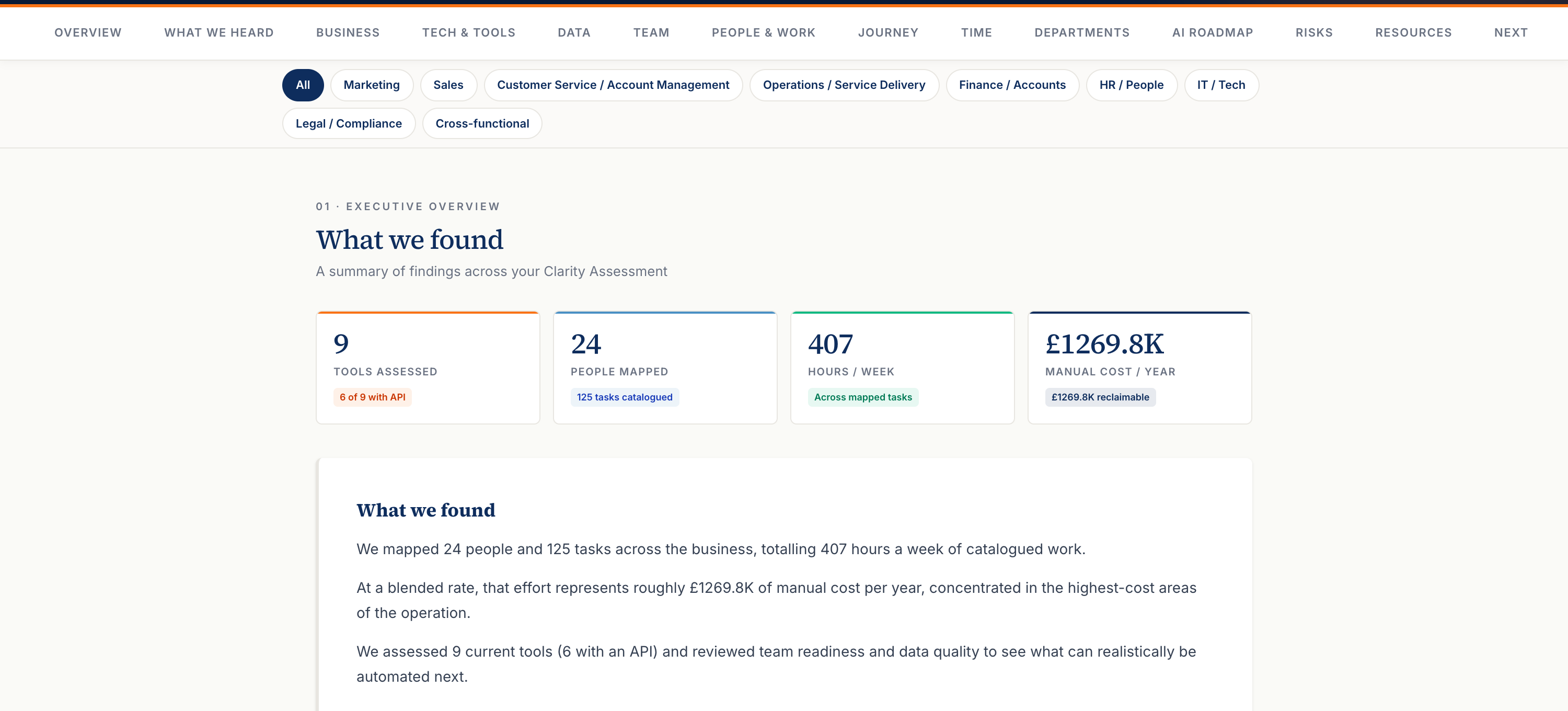
How the business actually runs today, department by department, and what each inefficiency costs you a year. Every finding carries a number, because a finding without one is an opinion.

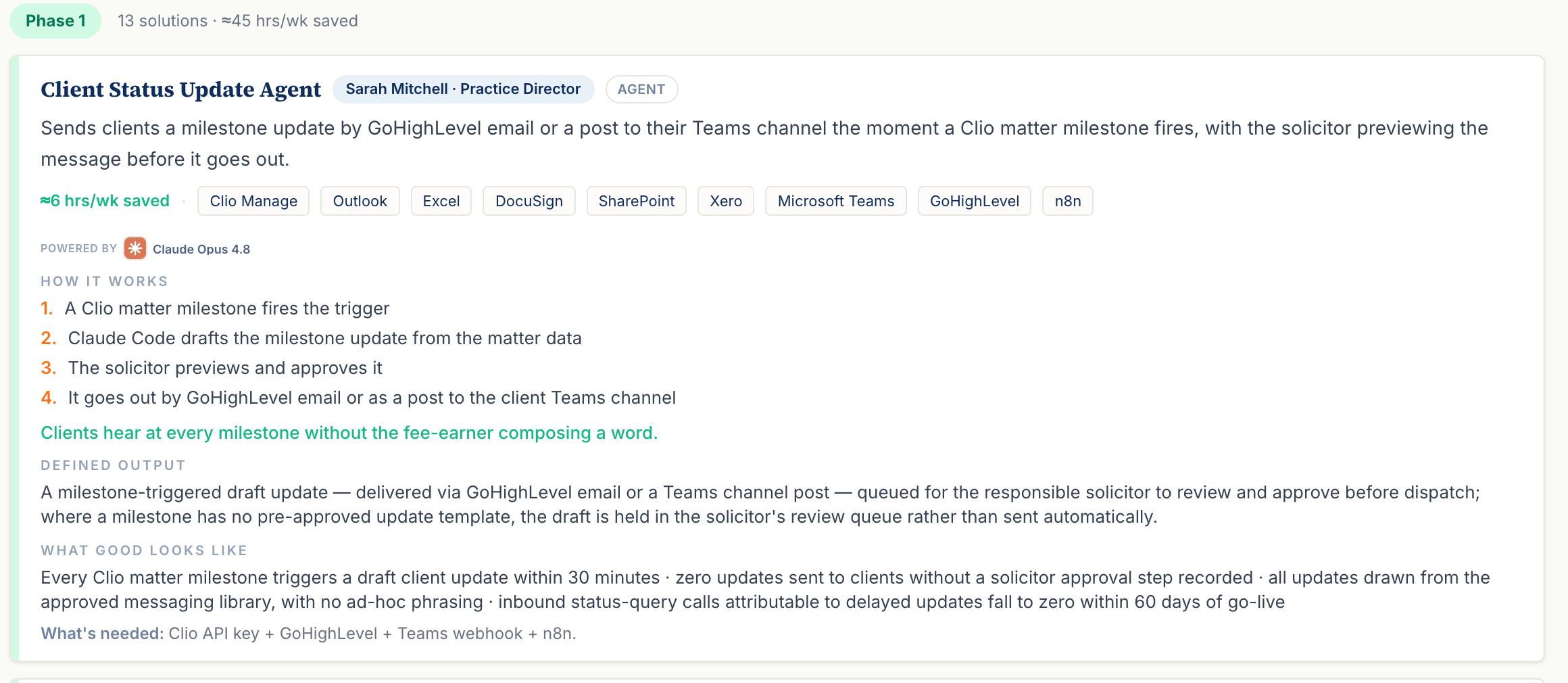
What to do first, second and third. Phased, sequenced and costed, so you can stop after any phase and still be ahead of where you started.

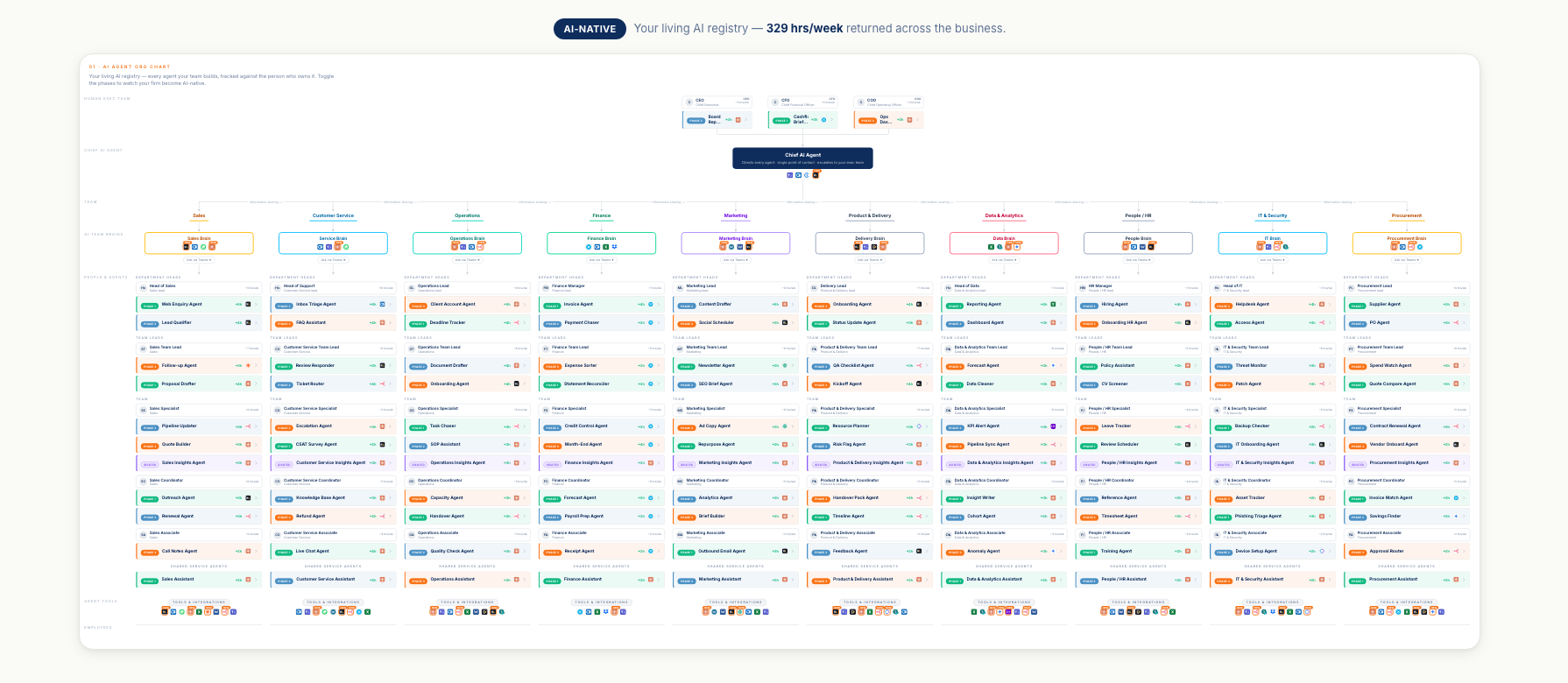
Your org chart the way it looks afterwards, with the AI roles on it and a named human owning each one. The answer to "so what does my business actually look like when this is done?"

Onboarding goes out to everyone involved on day one, so nobody is surprised by a calendar invite from a consultant they've never heard of.
Your time: about 2 hours, mostly the kickoff
Your team: 45 minutes each, one person per department
Your time: 90 minutes for the walkthrough
A written map of how the business runs — that survives the person who knows it best resigning.
A ranked plan with a number against every line — so the next decision is a yes or a no, not a debate.
An org chart with AI roles on it, and the name of the human accountable for each one.
An AI policy your people can actually follow, and your auditor can actually read.
A keep-or-replace view of your tech stack, including subscriptions you'd forgotten you were paying for.
A leadership team that agrees on what happens first — usually the part that was actually missing.
Before we talk about what it costs: tell me what's missing. If something here doesn't apply to your business, the next section should change shape, not the price.
Both end with the same deliverables in your hands. The difference is whether your people spend the hours capturing the business, or we do.
Done with you · 3 weeks
Right when you have someone internally with roughly four hours a week to do the capture work.
Done for you · 3 weeks
Right when the people who hold the knowledge are the people with no spare time. Which is most businesses.
Twenty minutes. We work out which of the two fits, or whether neither does. If it's neither, you'll leave with the two things you should go and do yourself anyway.
Most companies that finish Clarity go on to build the first phase with us over the following six months. That's a separate conversation with a separate number, and it happens in week four — never during the sprint.